Residents of Pedra Branca (Santa Teresinha, Bahia) folklore
In Pedra Branca the bird is called saracura, três-potes or sete-potes (three pots or seven pots), a name taken from its voice, and an older resident describes it as the little bird that lives in the water.
Source: A. T. Galvagne-Loss and E. M. Costa-Neto, Ecología de las aves de acuerdo a los habitantes del poblado de Pedra Branca, El Hornero 32(1), 2017 — elhornero.avesargentinas.org.ar/home/article/dow…
The message
Two voices together set the rhythm of the day. Sing with those beside you.
What it sounds like
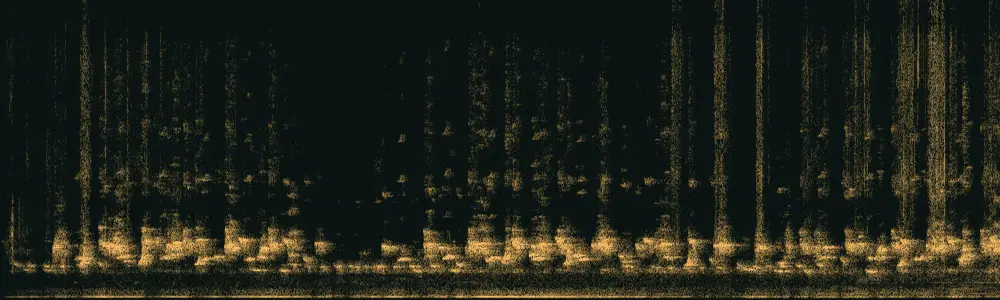
A loud, deep, rhythmic duet of the pair, which people hear as "três-potes, um-coco" (three pots, one coconut), sometimes in chorus with neighbors. Most common at dawn and dusk.
The frequency of the song
Main frequency
1,647 Hz
Note
G#6
Range
1,130 Hz–1,755 Hz
Rhythm
moderate
Tone
pure, whistled
Binaural tone
205.88 Hz
We measured this recording by computer, removing background noise. Canto Ancestral's binaural sound uses the bird's main note, brought to 205.88 Hz, close to the tone used in studies. Understand binaural beats.
For which moment
Expression, vitality. Both states come from the sound: a loud, rhythmic duet, in which each bird sings a part and which gave the species its name. Birdsong.
Frequently asked questions
What is the spiritual meaning of this bird?
It depends on the people. Brazilian folk belief: Folk belief says that the wood-rail's song, heard at dawn and in the late afternoon, is a sign of rain.
What does its song sound like?
A loud, deep, rhythmic duet of the pair, which people hear as "três-potes, um-coco" (three pots, one coconut), sometimes in chorus with neighbors. Most common at dawn and dusk.
What is the frequency of its song?
In the recording we use, the main frequency was 1,647 Hz, close to the note G#6, with most of the sound between 1,130 Hz and 1,755 Hz.
Does this song help you relax?
Both states come from the sound: a loud, rhythmic duet, in which each bird sings a part and which gave the species its name. Studies link bird sounds to less stress, but none tested this species in particular.